Showing posts with label communication. Show all posts

Friday, November 21, 2008

Dance as an Collaborative Art


…Yea, I really cannot get enough of performance based arts. Because I have not had an incredible amount of experience in performance art, everything I find and explore has an enlightening appeal to it - much like if one was to uncover lost treasure. Although I might be partially exaggerating this wave of feelings that I get.


But seriously now, all these posts I have mentioned had to do with collaborated arts in which people speak face to face. What about if they didn’t? What if they didn’t speak face to face in the sense that no spoken word is communicated? What I would like to introduce is a collaborative art that is less vocally direct - dance. Dance as a form of collaborative art; an art in which communication is in the form of body movements.

Body language is often overlooked as people tend to put more meaning into spoken language. This is pretty much expected in that words are often more definable and give a solid explanation. Although it is tough to find the right words that a performer wishes to speak with the body, it certainly adds another level of connection with the audience. When one views the intricate movements played out by the dancers, our minds are put to work to make sense of it all. Even when there are no words, people are generally intuitive as to the emotions that are trying to be explained in such gestures.

What I enjoy about having a less direct form of communication such as the spoken language, is that body language leaves it to the viewer to interpret what is being said. And when it comes to interpretation, it is based off one’s own culture, background, experiences, etc. Thus, every interpretation is different. So when people explain a work of art or a performance in a straightforward explanation, it probably isn’t entirely true or entirely complete. Art is what you personally make of it.

Anyway, I just wanted to highlight an interesting dance group. They are called “China Disabled People's Performing Art Troupe”. This was partly why I was interested in exploring dance as a collaborated art and the connection that is formed between the performers without words. These performers are all hearing impaired so they do not communicate with the song played in the background – rather, they communicate with one another through the movements made prior to theirs. It was really amazing and inspiring to see their triumph over their disability and that they could do something so intricate through movements.

Thursday, November 20, 2008

Flash Mobs

The preconceptions of art are pretty vested in the idea that it is an activity based soley on individual actions. Performance based art emerged and soon became a celebration of collaboration.

One of these mentioned arts is flash mobs - an example in which art deconstructs the stereotype that was created out of traditional art. Similar to Improv Everywhere, flash mob is a performative piece. A flash mob is an event in which a large number of people congregate at a certain place and perform a named activity for a certain amount of time. After completion of the named activity, the participants disperse as if nothing happened.

Flash mobs were first created by Bill Wasik in 2003. At first, the intentions of flash mobs were purely experimental. The socio-cultural experiment that was being conducted was to explore the psychological "needs" of people to fit into a particular "identification" - also known simply as conformity.

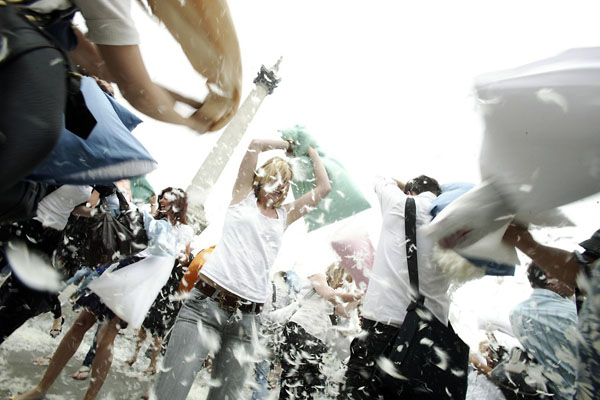
The idea that people would do something entirely ridiculous, such as having a world pillow fight, would invite many others to join. People are more willing to do these socially and cultural unacceptable acts when there is encouragement from a group. It’s all part of the sheep mentality – finding your flock to mingle with. I feel this experiment was a good way of bringing attention to the idea of how people react in social situations, especially since it gives a personal insight to analyze oneself.

Anyway, as this experimentation played out, it became more of a trend and part of an underground subculture. Although its intentions were to mock the idea of conformity, flash mobs took an unexpected turn and ironically, people embraced it. The Vancouver Sun wrote, "It may have backfired on him... [Wasik] may instead have ended up giving conformity a vehicle that allowed it to appear nonconforming." Flash mobs became popular for being “unconformist” and turned into a huge performative art venture.

Flash mobs, Improv Everywhere, and other collaborative based works in which random participants join, build a sense of community. In due time, they will perhaps, break the social and cultural barriers that dictate how a person acts when confronted by a total stranger. These norms tell us that we should be rigid, in our place, and “normal”. These sort of barriers tend to keep us from say, turning our head on the bus to talk to a stranger. I deal with this type of harsh mentality too – the kind where you create a space between you and a stranger. Perhaps part of the paranoia stems from the fact that the media tends to inflict a certain amount of fear. The fear of “don’t take candy from strangers” because the media tends to exaggerate the amount of kidnappings, rapes, and etc, that really happen in the world.

People fail to realize that we are all similar beings. We have favorite foods, favorite bands, and stuff like that. With these flash mobs and Improv Everywhere, I feel as if any conversation or word spoken between random strangers is a nice triumph over the spaces that society’s “norms” have shaped for us. I guess we all just have to start looking at people from a different perspective, such as how similar we are as opposed to how different.

I think I may be starting to go off to a tangent now.

Sunday, October 19, 2008

Great Success

So a couple of weeks ago on a particular uninspiring night after having a late dinner at a noodle place with my friend Chris, we decided to check out a local tattoo shop. It was a small shop, glowing with neon purple "OPEN" and lights - this was a really obscure shop that was was tucked away behind a large food mall, pretty much exiled to the corner.

We walked in when the store was closed (yes, the neon "OPEN" signs were rather deceiving). There were other similar aged people and we somehow got engaged in their discussion. (Or rather, it was more like a lecture by this one tattooist named Andy.) He was medium built, medium height, medium age, etc. But this Andy didn't have as average thoughts about art. He had big ideas to share. He showed us a youtube video called Art Fusion Experiment.

The premise of Art Fusion is pretty simple:

"...to help each other, work together, get to know each other more." - taken from the video.

It started out as a tattooist experimenting with a group other tattooists. They wanted to break from the mean and try something completely unheard of - working collaboratively and freehandedly on a full body tattoo. They were met with great success, so great that Borat would approve. This group then decided to take the ideas to the gallery walls. They again were met with success and gained the approval of institutional art critics.

This method of working collaboratively to create art is innovative in many ways:

(1.) communication in the art process - typically unheard of because traditionally, an artist would work alone

(2.) new styles/forms of art - by combining two artists styles, you get a nice fusion style that the world has never seen. I guess a comparison would be like watching the chef Ming Tsai cook a fusion of Asian-European cuisine on "East meets West" on FoodTV.

(3.) collapse of the ego - I may have phrased that incorrectly because it sounds more negative than positive. But anyway, it basically breaks down the external pressures on an artist to create a magnificent piece of art that completely puts other artists work in the dust. In collaborative art, every artist contributing to the work is not pressured to compete with other artists - thus, makes for an enriching experience. According to Wikipedia, who can say this more eloquently:

"Any one artist could spend an hour detailing an element of a canvas and in the blink of an eye, another artist may step in and change it entirely. Though this presents the most frustrating element of the exercise, it is an integral part of the ego-cleansing process that is so inherent of ArtFusion Camp. As a result, a newfound unity develops between the artists. Through the chaos that is the ArtFusion Experiment, many harmonies reveal themselves."


This video really inspired me to think a lot about collaborative arts It is also why I created this blog. I wanted to both explore concepts behind working together and communicating for art and also to share whatever insights or fun facts I come across.

"Great Success!"

Monday, October 13, 2008

Introduction

A man walks down a pristine hallway of a museum in quiet contemplation. An ornately framed painting is hung at eye-level. The man then proceeds to step directly across the artwork, viewing the work at a distance and with such scrutiny.

This description is a rather popular conception of art. One typically imagines art to consist of:

(1). artist
(2.) artwork
(3.) viewer

I thought that way until I went to UC Irvine. I was surprised to learn during my lectures that art is not just limited to an aesthetically pleasing image. Rather, it consists of communicative experiences that initiates a process of dialogue between people.

As a student of the arts, I feel that I should share what I have learned and experienced about the other aspects of art and its forms - especially when it involves more than one person at a time. Collaborative arts stresses the importance of communication.

..In fact, blogging on the internet could be seen as an art piece as it involves many people communicating over cyberspace.

(o O:)3